Blue Ocean Event (BOE)
A Blue Ocean Event (BOE) occurs when the size of the sea ice falls to 1 million km² or less, which could occur when it's Summer in the Northern Hemisphere for Arctic sea ice or when it's Winter in the Northern Hemisphere for Antarctic sea ice.
A BOE can be defined as a tipping point that is crossed when sea ice reaches or falls below 1 million km² in extent. Alternatively, the tipping point could be defined as 1 million km² in sea ice area, or as 1 thousand km³ in sea ice volume.
A BOE can be defined as a tipping point that is crossed when sea ice reaches or falls below 1 million km² in extent. Alternatively, the tipping point could be defined as 1 million km² in sea ice area, or as 1 thousand km³ in sea ice volume.
A Double Blue Ocean Event could occur soon, combining two Blue Ocean Events, i.e. an Arctic Blue Ocean Event occurring in Summer 2026 in the Northern Hemisphere and an Antarctic Blue Ocean Event occurring in early 2027, as the 2026 El Niño keeps its strength while the temperature rise keeps accelerating, partly as a result of the Arctic Blue Ocean Event.
Crossing the tipping point can invoke many self-reinforcing feedbacks, resulting in a steep rise in temperature, in turn causing huge thawing of permafrost and thus further accelerating the temperature rise, as described below.
Albedo
Without sea ice, the surface has less reflectivity or albedo, i.e. less sunlight will be reflected back into space, and will instead be absorbed by the Arctic.

Sea ice reflects 50% to 70% of the incoming energy, while thick sea ice covered with snow reflects as much as 90% of the incoming solar radiation. The ocean reflects only 6% of the incoming solar radiation and absorbs the rest.
 |
| [ image from earlier post ] |
This partly explains why the temperature rise is strongest in the Arctic, as illustrated by the image on the right, adapted from NASA, which shows anomalies versus 1951-1980 of up to 3.88°C.
An analysis by Pistone et al., published 2014, found an additional 6.4 ± 0.9 W/m² of solar energy input into the Arctic Ocean region between 1979 and 2011. Averaged over the globe, this albedo decrease would correspond to a forcing that is 25% as large as that due to the change in CO₂ during this period.
This extra heat has not spread equally around the globe, but has especially raised temperatures in the Arctic, as is illustrated by the image.
Latent Heat
In addition to albedo loss due to the disappearance of Arctic sea ice, there is the loss of the sea ice acting as a latent heat buffer.
The amount of energy absorbed by melting ice is as much as it takes to heat an equivalent mass of water from zero to 80°C.

As the temperature of the ocean rises, ever less sea ice remains in the Arctic. Once the sea ice is gone, further heat arriving in the Arctic Ocean will strongly raise the water temperature and the atmosphere over the Arctic Ocean.
Arctic sea ice and ocean heat
Ocean heat is getting pushed along the path of the Gulf Stream from the North Atlantic through the Fram Strait into the Arctic Ocean and - to a lesser extent - from the North Pacific through the Bering Strait into the Arctic Ocean.
The image below, from an earlier post, shows sea surface temperatures as high as 33.3°C (or 91.94°F) around North America on August 2, 2026. The image also illustrates geographic conditions facilitating the Gulf Stream to push ocean heat north in the Atlantic Ocean toward the Arctic.
The image below shows that the sea surface temperature was 21.05°C on July 31, 2026, an anomaly of 0.64°C from 1991-2020. The image below, from an earlier post, shows sea surface temperatures as high as 33.3°C (or 91.94°F) around North America on August 2, 2026. The image also illustrates geographic conditions facilitating the Gulf Stream to push ocean heat north in the Atlantic Ocean toward the Arctic.
 |
| [ Sea surface temperatures as high as 33.3°C, click on images to enlarge ] |

The image below, from an earlier post, shows sea surface temperature anomalies versus 1971-2000 on July 31, 2026. A huge amount of ocean heat has accumulated in the Pacific Ocean and in the Atlantic Ocean, overwhelming colder areas that were previously present in the oceans.

The combination image below, from an earlier post, shows Arctic sea ice concentration (left) and Arctic sea ice thickness (right) on July 31, 2026.

Rising air and sea surface temperatures threaten to devastate sea ice. Arctic sea ice typically reaches its minimum extent in September. An Arctic Blue Ocean Event would strongly speed up acceleration of the temperature rise. The 2026 El Niño looks set to continue into early 2027. Antarctic sea ice typically reaches its minimum extent in February, so an Antarctic Blue Ocean Event could follow an Arctic Blue Ocean Event.
Extinction
The 2026 El Niño threatens to strike with unprecedented ferocity triggering many events and developments to unfold incl. extinction of most species (including humans):
1. Arctic snow and ice cover decline, coming with loss of latent heat buffer and with loss of albedo (sea ice + permafrost), and
2. destabilization of methane hydrates causing eruption of vast amounts of methane that further speed up Arctic warming and thus cause further thawing of the terrestrial permafrost, resulting in even more emissions,
2. destabilization of methane hydrates causing eruption of vast amounts of methane that further speed up Arctic warming and thus cause further thawing of the terrestrial permafrost, resulting in even more emissions,
3. while the Jet Stream gets more deformed, causing more extreme weather events, incl. heatwaves and forest fires, at first in Canada, Siberia and Europe and then in peatfields, forests, landfills, warehouses, oil depots and munition depots all over the world, also causing
4. decline of snow and ice on mountains, at first causing huge flooding, followed by droughts, heatwaves and more fires, causing collapse of the Greenland and West-Antarctic ice sheets, and causing abrupt sea level rise that in combination with huge storms
5. will cause collapse of industrial activity that will in turn cause the aerosol masking effect to fall away, further driving up the temperature rise and causing further emissions of gases and particulates from wood and waste burning (that many will resort to for cooking and heating) and from biomass decomposition, and more feedbacks, incl. water vapor, falling away of lower clouds, more cirrus clouds, albedo changes and heat rising up from oceans.
 |
| [ Temperature in Greenland of 21.5°C or 70.7°F on July 3, 2026 - click on images to enlarge ] |
Importantly, depicted above is only one scenario out of many. Things may eventuate differently and in different order, or occur simultaneously, i.e. instead of one domino tipping over the next one sequentially, many events may occur simultaneously and amplify each other. Further events and developments could be added, such as ocean stratification and formation of a freshwater lid at the surface of the North Atlantic that could facilitate cyclones to suddenly push large amounts of warm, salty water into the Arctic Ocean, triggering destabilization of sediments that contain huge amounts of methane in the form of hydrates and in the form of free gas underneath such hydrates.
Methane hydrates
The image below, from an earlier post, illustrates the danger of thinning of Arctic sea ice resulting in increased ocean heat and methane eruptions.
 |
| [ The Buffer is gone ] |
The image below, adapted from a 2026 study, depicts the origin of methane releases, i.e. methane from hydrates and methane in the form of free gas (natural gas).

Such events could enable more warm, salty water to travel from the Atlantic Ocean into the Arctic Ocean, pushing up temperatures and salinity levels at the bottom of the Arctic Ocean to a point beyond which they destabilize methane hydrates that are contained in sediments at the seafloor of the Arctic Ocean, resulting in massive eruptions of methane from these hydrates and from free gas underneath.
Clouds tipping point
Such eruptions of methane could, on their own, cause the 1200 ppm CO₂e cloud feedback tipping point to be crossed, which in turn can cause global temperatures to rise by 8°C, as discussed in this earlier post.
Further feedbacks of the rising temperatures can make the situation even more threatening, e.g. more methane over the Arctic would push up temperatures locally over the Arctic Ocean as well as over the permafrost on land. Loss of terrestrial permafrost can result in huge releases of greenhouse gases and in albedo changes that could equal those resulting from sea ice loss. Further feedbacks also include changes to clouds, as also discussed at the clouds feedback page.
Huge temperature rise
 |
| [ from the Extinction page ] |
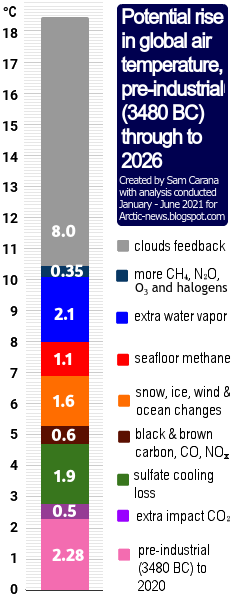
In summary, a huge temperature rise in the Arctic looks set to unfold, triggered by the combined impact of an upcoming El Niño and loss of the latent heat buffer and albedo losses due to further sea ice decline.
As temperatures keep rising, changes to the Jet Stream and ocean currents look set to intensify. Further feedbacks include permafrost degradation, both terrestrial and on the seafloor of the Arctic Ocean.
The danger is that this will cause huge releases of greenhouse gases (particularly CO₂, CH₄ and N₂O), in turn also causing more water vapor to enter the atmosphere, all contributing to a huge rise in temperature, especially in the Arctic, where vast amounts of methane are contained in sediments at the seafloor and where very little hydroxyl is present in the atmosphere to break down methane.
Temperatures looks set to rise further due to the falling away of sulfate aerosols, while there could be a further temperature rise due to releases of other aerosols that have a net warming impact, such as black and brown carbon, which can increase dramatically as more wood burning and forest fires take place.
As the temperature keeps rising, further self-reinforcing feedbacks will kick in with more ferocity such as an increase in water vapor globally, combined with more cirrus clouds and a decrease in lower clouds decks, further increasing the temperature, as described at the clouds feedback page.
Altogether, the temperature could rise by more than 18°C (calculated from pre-industrial), as illustrated by the image on the right from the Extinction page.
Conclusion
In conclusion, the danger is that temperatures will rise strongly in 2026, resulting in humans going extinct, making it in many respects rather futile to speculate about what will happen beyond 2026. On the other hand, the right thing to do is to help avoid the worst things from happening, through comprehensive and effective action as described in the Climate Plan.
The situation is dire and unacceptably dangerous, and the precautionary principle necessitates the danger to be acknowledged, while facilitating rapid, comprehensive and effective action to reduce the damage and to improve the outlook, where needed in combination with a Climate Emergency Declaration, as described in posts such as in this 2022 post and this 2025 post, and as discussed in the Climate Plan group.

Links
• PIOMAS Sea Ice Volume Data, 1979-present
http://psc.apl.uw.edu/research/projects/arctic-sea-ice-volume-anomaly/data
• Most Important Message Ever
https://arctic-news.blogspot.com/2019/07/most-important-message-ever.html
• Albedo
https://arctic-news.blogspot.com/p/albedo.html
• Latent Heat
https://arctic-news.blogspot.com/p/latent-heat.html
• Cold freshwater lid on North Atlantic
https://arctic-news.blogspot.com/p/cold-freshwater-lid-on-north-atlantic.html
• Jet Stream
https://arctic-news.blogspot.com/p/jet-stream.html
• Feedbacks
https://arctic-news.blogspot.com/p/feedbacks.html
• Blue Ocean Event
https://arctic-news.blogspot.com/p/blue-ocean-event.html
• Insolation
https://arctic-news.blogspot.com/p/insolation.html
• Extinction
https://arctic-news.blogspot.com/p/extinction.html
• Clouds feedback
https://arctic-news.blogspot.com/p/clouds-feedback.html
• Double Blue Ocean Event 2026-2027?
https://arctic-news.blogspot.com/2026/04/double-blue-ocean-event-2026-2027.html
• Double Blue Ocean Event 2026-2027? - update
https://arctic-news.blogspot.com/2026/06/double-blue-ocean-event-2026-2027-update.html
• Climate Plan
https://arctic-news.blogspot.com/p/climateplan.html
http://psc.apl.uw.edu/research/projects/arctic-sea-ice-volume-anomaly/data
• Most Important Message Ever
https://arctic-news.blogspot.com/2019/07/most-important-message-ever.html
• Albedo
https://arctic-news.blogspot.com/p/albedo.html
• Latent Heat
https://arctic-news.blogspot.com/p/latent-heat.html
• Cold freshwater lid on North Atlantic
https://arctic-news.blogspot.com/p/cold-freshwater-lid-on-north-atlantic.html
• Jet Stream
https://arctic-news.blogspot.com/p/jet-stream.html
• Feedbacks
https://arctic-news.blogspot.com/p/feedbacks.html
• Blue Ocean Event
https://arctic-news.blogspot.com/p/blue-ocean-event.html
• Insolation
https://arctic-news.blogspot.com/p/insolation.html
• Extinction
https://arctic-news.blogspot.com/p/extinction.html
• Clouds feedback
https://arctic-news.blogspot.com/p/clouds-feedback.html
• Double Blue Ocean Event 2026-2027?
https://arctic-news.blogspot.com/2026/04/double-blue-ocean-event-2026-2027.html
• Double Blue Ocean Event 2026-2027? - update
https://arctic-news.blogspot.com/2026/06/double-blue-ocean-event-2026-2027-update.html
• Climate Plan
https://arctic-news.blogspot.com/p/climateplan.html
