Showing posts with label GWP. Show all posts

Friday, March 6, 2026

Clouds Tipping Point

Clouds Tipping Point

The PBS Terra video below features the clouds tipping point, as also discussed in a recent post at the ArcticNews group.  


The video mentions the 2019 analysis by Tapio Schneider that stratocumulus cloud decks become unstable and break up into scattered clouds when CO₂ levels rise above 1200 ppm, resulting in an abrupt additional temperature rise of 8°C (14°F), as discussed at the Clouds Tipping Point page

The SSP5-8.5 pathway (Shared Socioeconomic Pathway, used by the IPCC), corresponding with a radiative forcing of 8.5 W/m⁻² in 2100, projects CO₂ concentration rises to levels as high 2206.4 ppm in the year 2250, i.e. well above 1200 ppm, as illustrated by the image below, from a 2020 study led by Malte Meinshausen. So, how much temperature rise could this cause? 

SSP5-8.5 is often said to be a "worst-case" scenario, yet current developments may even exceed SSP5-8.5 projections, as discussed in an earlier post. The image below features in IPCC AR6 WG1 SPM. The total warming of the IPCC pathways (panel b) is dominated by CO₂ emissions that keep growing steadily in SSP5-8.5, while the maximum temperature rise stays well below 6°C. 


Is this in conflict with the additional 8°C rise when the Clouds Tipping Point gets crossed? Let's analyze this. Importantly, the Clouds Tipping Points is at 1200 CO₂e, with contributions not only from CO₂, but also from methane, water vapor, etc.  

[ from earlier post ]
Reductions in methane emissions can strongly reduce the total CO₂e, given methane's high Global Warming Potential (GWP). Could reductions in methane emissions keep the total CO₂e below 1200 ppm? In both the SSP1-1.9 and SSP1-2.6 pathways, methane emissions would fall after 2015, and methane emissions would also fall over time for SSP2-4.5, in which 2°C does get crossed, and for SSP5-8.5.

So, if the impact of methane is high and if methane emissions would strongly decline, could it be possible that 1200 CO₂e wouldn't get crossed? Conversely though, if growth in methane emissions continues, this can strongly push up the total CO₂e, as occurs in SSP3-7.0, but in that pathway there are less CO₂ emissions and less reductions in sulfur dioxide emissions.

Anyway, what happened after 2015, the year when politicians pledged at the Paris Agreement to take efforts to limit the temperature rise to 1.5°C? Lo and behold, methane emissions kept rising after 2015! There was record growth in methane concentrations in 2021, after which there was a bit of a slowdown in growth during the following years, but growth in methane concentration picked up pace again recently, as illustrated by the image below, from an earlier post.


So, it appears again that SSP5-8.5 isn't the "worst-case scenario" in more than one way. An even worse case scenario would see strong emissions of both CO₂ and methane. Once more, it appears that politicians and collaborating scientists have been downplaying the temperature rise that is about to unfold. The IPCC produced a special report, called Global Warming of 1.5 °C above pre-industrial levels and related global greenhouse gas emission pathways and the report's pathways don't seem to make sense in many ways, as also discussed in an earlier post

The image below is also from that earlier post. The image depicts an alternative pathway in which methane concentrations grow in line with the added magenta-colored trend that points at methane more than doubling by 2043. Such developments should have been included, at least in the margin of uncertainty, i.e. as a potential development. 

The above text and images describe and depict horrendous dangers, yet the IPCC remains silent, refusing to warn people about the dangers and refusing to recommend effective policy pathways. Note that methane is only one of the contributors to a potentially horrific rise in temperature in the Arctic.

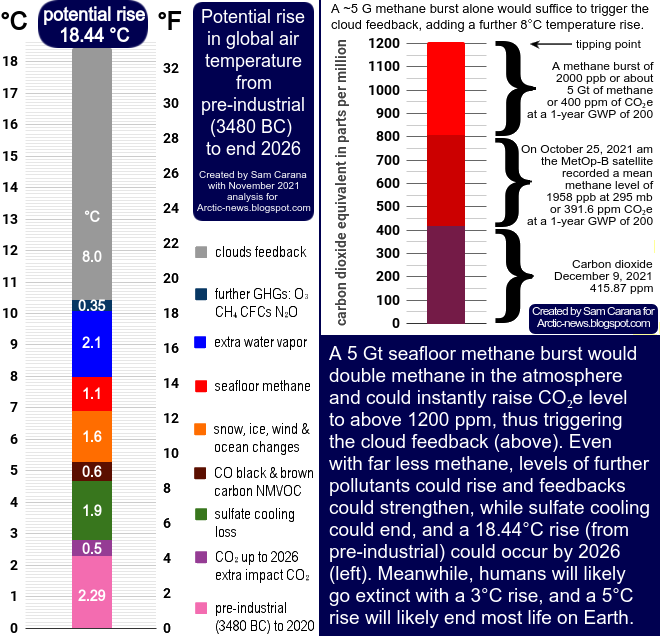
Such developments were discussed in a 2021 post that featured the image below, with the caption that a 5 Gt burst of seafloor methane would double the methane in the atmosphere and could instantly raise CO₂e level to above 1200 ppm, thus triggering the cloud feedback (panel top right). Even with far less methane, levels of further pollutants could rise and feedbacks could strengthen, while sulfate cooling could end, and a 18.44°C rise (from pre-industrial) could occur by 2026 (left panel).

How appropriate is the use of a multiplier of 200 to convert the impact of methane in parts per million (ppm) methane to ppm CO₂e? After all, carbon dioxide equivalence (CO₂e) was introduced by politicians in the Kyoto Protocol, which was adopted in 1997 and uses a Global Warming Potential (GWP) of greenhouse gases over a 100-year horizon to calculate their carbon dioxide equivalence. Is GWP a tool behind specific politics? How much sense does it make to calculate methane's GWP over 100 years, given that methane's atmospheric perturbation lifetime is less than 12 years and methane has its highest impact immediately after it enters the atmosphere? What multiplier should be used to calculate the impact of an extra 5 Gt of methane? 

The image on the right, from an earlier post, shows trends based on IPCC AR6 GWP values pointing at a GWP for methane of 150 for a 9-year horizon and pointing at an even higher GWP for a shorter horizon. 

A short horizon makes sense when calculating the immediate impact of, say, a 5 Gt burst of methane from the seafloor of the Arctic Ocean.

There are other ways to calculate the impact, e.g. one can also look at radiative forcing. It makes sense to also take into account the indirect impact of methane, as done in the image below. The image conceptually dates back to 2019 when the analysis by Tapio Schneider et al. was published, hence the use of radiative forcing from the IPCC AR5 WG1 SPM report that was published in 2013.

The image below shows three blocks each of about 400 ppm CO₂e, adding up to 1200 ppm CO₂e. The bottom block (purple) represents the CO₂ present in the atmosphere, i.e. on May 9, 2013, CO₂ surpassed 400 ppm at Mauna Loa. It is noted that extra CO₂ has less impact as its abundance grows, whereas extra CH₄ has a stronger impact.

The block in the middle (dark red) shows the methane already in the atmosphere, with the note that IPCC AR5 gives CH₄ an impact of 0.97 W/m⁻² (see top of image), or 57.74% of the impact of about 400 ppm CO₂. Yet, the impact of methane could rise to 400 ppm CO₂e, for reasons described in the following paragraph. 

The spectral band where most heat is trapped by CO₂ is more saturated than the band where most heat is trapped by CH₄. The impact of additional CH₄ will increase as its abundance grows, whereas the impact of additional CO₂ will decrease as abundance grows. Abrupt eruptions of 5 Gt of seafloor CH₄ will cause hydroxyl depletion. Since there is already very little hydroxyl present over the Arctic, large eruptions of CH₄ from the seafloor of the Arctic Ocean would strongly increase the lifetime of CH₄ there, trigger feedbacks and increase its global warming impact. The warming impact of an extra 5 Gt of CH₄ could therefore approach the impact of the CO₂ that was in the atmosphere on May 9, 2013, and this would not only apply to the methane that is added by such eruptions, but it would also increase the impact of CH₄ already present in the atmosphere. 

The block of 400 ppm CO₂e at the top of the bar (red) represents an extra 5 Gt of CH₄ resulting from a burst of methane erupting from the seafloor of the Arctic Ocean. Some of the methane arising from the seafloor will be broken down in the water by microbes, but many of the seas in the Arctic Ocean are very shallow and when large amounts of methane erupt in the form of plumes and move at high speed through the water column, only a small part of the methane can be broken down on its way up through the water column. Anyway, the point is that 5 Gt of methane abruptly entering the atmosphere could have an immediate impact of 400 ppm CO₂e which would also raise the impact of the block of existing CH₄ to 400 ppm CO₂e. 


Jointly, the three blocks each of 400 ppm CO₂e add up to 1200 ppm CO₂e, i.e. the tipping point where stratocumulus decks start to disappear abruptly, resulting in an additional temperature rise of 8°C. Even when CO₂ levels are lowered again after the stratocumulus breakup, the stratocumulus decks only reform once the CO₂ levels drop below 300 ppm, as discussed at the Clouds Tipping Point page.

Historic growth in methane concentrations

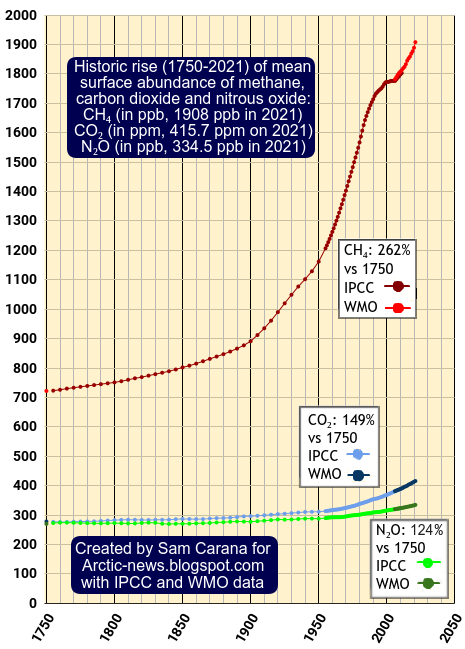
Historic records could have given a stronger warning than the IPCC pathways. Methane has historically risen faster than CO₂. As illustrated by the image on the right, based on IPCC and WMO data, and from an earlier post, methane in 2024 was 266% of what it was in 1750, whereas CO₂ in 2024 was 152% of what it was in 1750. 

In fact, the rise in emission by people had already started well before 1750. Thousands of years ago emissions started to grow in agriculture, herding of animals and associated deforestation, as illustrated by the combination image below, adopted from Ruddiman et al. (2015)

Thousands of years ago, methane concentrations were as low as 550 ppb, while CO₂ concentrations were as low as 260 ppm. So, methane in 2024 was 335% of what it was thousands of years ago, whereas CO₂ in 2024 was 163% of what it was thousands of years ago. In other words, methane concentrations have risen twice as fast as CO₂ concentrations.  

[ from earlier post ]
As discussed in earlier posts such as this one and this one, the IPCC keeps downplaying the dangers that we're facing, and one way the IPCC does so is by manipulating the outlook of CO₂, methane and sulfur dioxide emissions. Another way is to downplay the historic temperature rise, which is important, since a larger historic rise would also come with more water vapor in the air, a powerful greenhouse gas that causes a self-amplifying feedback further increasing the temperature rise. 

Existential threat

So, are we facing an existential threat? The speed at which temperatures are rising is unprecedented in the historic record. Historically, people have been pushing up the temperature for thousands of years, due to deforestation and further activities by people.  

[ image from Tierney et al (2025), also discussed at ArcticNews group ]
Activities by people have been pushing up the temperature from a genuinely pre-industrial base for thousands of years, maybe by more than 2°C, as illustrated by the bottom panels on the image below.

The above image, from an earlier post, illustrates that, in the Northern Hemisphere, 2025 was the third year in a row with temperature anomalies more than 1.5°C above 1951-1980 and much more when compared to pre-industrial, as discussed in the inset. Note also that El Niño wasn't elevating temperatures in 2025.

[ from the post When will humans go extinct? ]
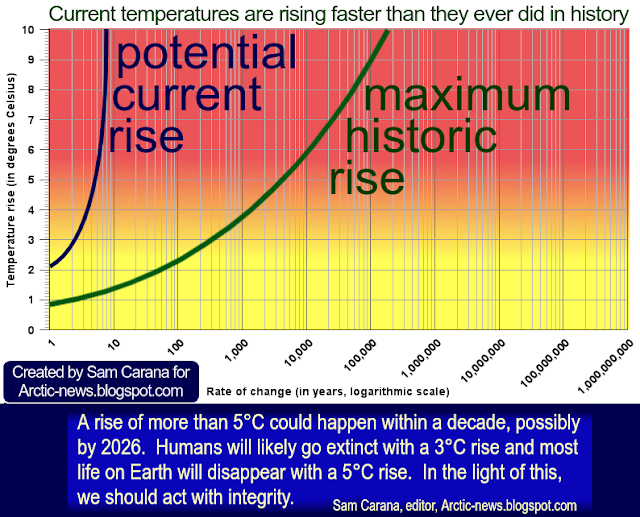
A 3°C rise constitutes an important threshold, since humans will likely go extinct with such a rise. The top panel in the above image shows a potential 10°C rise, while we may already be more than 2°C above pre-industrial. A further 1°C can quickly be added due to the move from a La Niña into the next El Niño, albedo loss and further feedbacks such as extra water vapor as temperatures rise, seafloor methane eruptions, fires, collapse of society causing abrupt termination of the sulfur aerosol masking effect. If society collapses, greenhouse gases with a high GWP and long lifetime could be emitted as substances leak from warehouses, waste dump fires, etc. Furthermore, aerosols from sulfur dioxide could fall out of the air in a matter of weeks, all contributing to a rapid temperature rise. 

The IPCC appears to have painted scenarios that are shrouded in dubious politics, rather than relating to best-available science and a realistic outlook on future developments. As an example, the speed in the projected decline in aerosols from sulfur dioxide in the various Shared Socioeconomic Pathways can make a huge difference. 

How  much could temperatures rise? James Hansen points out that equilibrium global warming for today’s GHG amount is 10°C, which is reduced to 8°C by today’s human-made aerosols. This 10°C rise is held back by oceans and ice acting as a buffer and by aerosols. How long would it take for a 10°C rise to unfold? Heat sinks could abruptly turn into sources, e.g. due to sea ice loss and changes in wind, soil and oceans such as ocean stratification. 

Keep in mind that concentrations of greenhouse gases are still rising. Also keep in mind that the land-only temperature rise is higher than the global rise and most people live on land. Many people also live in areas where the rise is stronger than average during heatwaves and due to the Urban Heat Island effect. The conclusion is that humans are functionally extinct if temperatures keep rising. Importantly, changes in biodiversity can have terrible consequences, and much of this is ignored by the IPCC. 

Biodiversity collapse

   [ from: When Will We Die? ]
A 2025 analysis by David Fastivich et al. finds that, historically, vegetation responded at timescales from hundreds to tens of thousands of years, but not at timescales shorter than about 150 years. It takes centuries for tree populations to adapt - far too slow to keep pace with today’s rapidly warming world. Vegetation depends on the presence of a lot of things including healthy soil, microbes, moisture, nutrients and habitat.

A 2025 analysis led by Thiago Gonçalves-Souza concludes that species turnover does not rescue biodiversity in fragmented landscapes.

A 2018 study by Strona & Bradshaw indicates that most life on Earth will disappear with a 5°C rise (see box on the right). Humans, who depend on a lot of other species, will likely go extinct with a 3°C, as discussed in the earlier post When Will We Die?

Terrestrial vertebrates are more in danger than many other species, as they depend on numerous other species for food. Humans are terrestrial vertebrates and humans are large warm-blooded mammals with high metabolic rates, thus requiring more food and habitat. It also takes humans many years to reach maturity. Humans have become addicted to processed food, fossil fuels, plastic, etc. Furthermore, humans require large amounts of fresh water, including for sweating when temperatures rise. A 3°C rise may therefore suffice to cause humans to go extinct, as discussed in earlier posts such as this one and this one

A 2025 analysis led by Joseph Williamson concludes that many species that live together appear to share remarkably similar thermal limits. That is to say, individuals of different species can tolerate temperatures up to similar points. This is deeply concerning as it suggests that, as ecosystems warm due to climate change, species will disappear from an ecosystem at the same time rather than gradually, resulting in sudden biodiversity loss. It also means that ecosystems may exhibit few symptoms of heat stress before a threshold of warming is passed and catastrophic losses occur. A 224 analysis by Michael Van Nuland et al. finds that tree symbioses with ectomycorrhizal fungi mean that they need to move together for successful migration. 

In the video below, Guy McPherson explains that forests cannot keep up with the speed at which temperatures are rising. 


Guy McPherson mentions the study by William Farfan-Rios et al. that finds that Amazonian and Andean tree communities are not tracking current climate warming. Further science snippets: The Amazon is also getting drier as deforestation shuts down atmospheric rivers. Thunderstorms are a major driver of tree death in tropical forests. Hot droughts cause catastrophic tree die-offs. Aboveground biomass in Australian tropical forests now a net carbon source.

Huge temperature rise

[ from the Extinction page ]
The image on the right illustrates how such dangers could be further amplified by the threat of war and collapse of centralized society. 

As people seek to occupy the last few habitable areas left, many people may stop showing up for work, resulting in a rapid loss of the aerosol masking effect, as industries that now co-emit cooling aerosols (such as sulfates) come to a grinding halt. As it becomes harder to obtain food and fuel for cooking and heating, and as the grid shuts down due to conflicts, many people may start collecting and burning more wood, decimating the forests that are left and resulting in more emissions that further speed up the temperature rise.

As temperatures rise, huge fires could also break out not only in forests, peatlands and grassland, but also in urban areas (including backyards, landfills and buildings, in particular warehouses containing flammable materials, chemicals and fluorinated gases), further contributing to more emissions that speed up the temperature rise.

As the likeliness of further accelerating warming, the severity of its impact, and the ubiquity and the imminence with which it will strike all become more clear and manifest—the more sobering it is that, while a mere 3°C rise may suffice to cause human extinction, a much larger temperature rise may unfold abruptly, as illustrated by the bar-chart on the right. 

The image below, from an earlier post, shows monthly data from May 2022 through May 2025, with a trend added that warns about 1200 parts per million (ppm) getting crossed in 2028.


As said, crossing the clouds tipping point at 1200 ppm CO₂ could - on its own - push temperatures up by 8°C globally, on top of the temperature rise caused by the forcing that resulted in the crossing of this tipping point. Moreover, the clouds tipping point is actually at 1200 ppm CO₂e (carbon dioxide equivalent), so when taking into account the impact of growth of other gases, strengthening feedbacks and further mechanisms, this tipping point could be crossed much earlier than in 2028, potentially as early as in 2026.

Methane in the atmosphere could be doubled within years if a trend unfolds as depicted in the image below, from an earlier post. A rapid rise is highlighted in the inset and reflected in the trend, which is based on January 2023-October 2024 methane data, as issued in February 2025.

[ Double the methane in March 2026? Image from earlier post, click on images to enlarge ]
A rise like the one depicted in the trend could eventuate as rising ocean heat destabilizes methane hydrates contained in sediments at the seafloor of the Arctic Ocean. The temperature rise in the Arctic would accelerate since the methane would initially have a huge temperature impact over the Arctic and cause depletion of hydroxyl, of which there is very little in the atmosphere over the Arctic in the first place. Such a rise in methane would also dramatically increase concentrations of ozone in the troposphere and concentrations of water vapor in the stratosphere. 

Climate Emergency Declaration

The situation is dire and unacceptably dangerous, and the precautionary principle necessitates rapid, comprehensive and effective action to reduce the damage and to improve the outlook, where needed in combination with a Climate Emergency Declaration, as described in posts such as in this 2022 post and this 2025 post, and as discussed in the Climate Plan group.


Links

• Clouds feedback and tipping point  

• Advances in Paleoclimate Data Assimilation - by Jessica Tierney et al. (2025) 

• Coupled, decoupled, and abrupt responses of vegetation to climate across timescales - by David Fastivich et al. (2025) 
• Amazonian and Andean tree communities are not tracking current climate warming - by William Farfan-Rios et al. (2025) 
https://www.pnas.org/doi/10.1073/pnas.2425619122

• Clustered warming tolerances and the nonlinear risks of biodiversity loss on a warming planet - by Joseph Williamson et al. (2025) 
https://royalsocietypublishing.org/rstb/article/380/1917/20230321/109625/Clustered-warming-tolerances-and-the-nonlinear

• Climate mismatches with ectomycorrhizal fungi contribute to migration lag in North American tree range shifts - by Michael van Nuland et al. (2024) 
https://www.pnas.org/doi/10.1073/pnas.2308811121

• Species turnover does not rescue biodiversity in fragmented landscapes - by Thiago Gonçalves-Souza et al. (2025)
https://www.nature.com/articles/s41586-025-08688-7
discussed on facebook at:
https://www.facebook.com/groups/arcticnews/posts/10162452301209679

• Transforming Society
https://arctic-news.blogspot.com/2022/10/transforming-society.html

• Climate Plan
https://arctic-news.blogspot.com/p/climateplan.html

• Climate Emergency Declaration
https://arctic-news.blogspot.com/p/climate-emergency-declaration.html

Wednesday, October 5, 2022

Methane keeps rising

WMO Report on Greenhouse Gases 

In 2020 and 2021, the global network of the World Meteorological Organization (WMO) detected the largest within-year increases (15 and 18 ppb, respectively) of atmospheric methane (CH₄) since systematic measurements began in the early 1980s. 

[ IPCC/WMO data through 2021 ]
The image on the right illustrates methane's rise, showing IPCC and, more recently, WMO data. Methane reached 1908 parts per billion (ppb) in 2021, 262% of the 1750 level, while carbon dioxide (CO₂) reached 415.7 parts per million (ppm) in 2021, 149% of the 1750 level, and nitrous oxide (N₂O) reached 334.5 ppb, 124% of the 1750 level. 

The WMO adds that analyses of measurements of the abundances of atmospheric CH₄ and its stable carbon isotope ratio ¹³C/¹²C (reported as δ¹³C(CH₄)) indicate that the increase in CH₄ since 2007 is associated with biogenic processes.

Methane's rise has been accelerating since 2007, which makes this a scary suggestion, as increasing decomposition of plant material as a result of climate change is a self-reinforcing feedback loop that is hard to stop.

Interestingly, a different explanation is pointed at in the 2019 analysis is shale gas a major driver of recent increase in global atmospheric methane?

Another explanation, discussed in an earlier post, is that there was a slowdown from 1984 to 2004 in the rise of methane as a result of rising temperatures increasing the water vapor in the atmosphere, resulting in more hydroxyl decomposing more methane in the atmosphere in the 1990s (compared to the 1980s). Accordingly, while the rise in methane concentration appeared to slow down over those years, methane emissions actually kept growing and continued to do so at accelerating pace, but since an increasingly large part of methane was decomposed by hydroxyl, this continuing rise in methane emissions was overlooked.

This could still mean that plant material is now getting decomposed at higher rates, but an even larger danger is that methane emissions started to increase more strongly from the early 2000s due in part to more methane eruptions from the seafloor of the Arctic Ocean. In other words, while hydroxyl kept increasing, seafloor methane emissions kept increasing even faster, to the extent that methane emissions increasingly started to overwhelm this growth in hydroxyl, resulting in a stronger rise in overall methane abundance in the atmosphere. 

Sadly, there are few measurements available for methane that could erupt from the seafloor of the Arctic Ocean. Moreover, WMO and NOAA data that are used to calculate global means are typically taken at marine surface level, which may be appropriate for carbon dioxide that is present more strongly at sea surface level, but methane is much lighter and will rise quickly and accumulate at higher altitude, as indicated by the satellite images further below. Moreover, the lack of measurements of methane over the Arctic Ocean and at higher altitudes makes it hard to determine from where the methane originated. Much methane could originate from the seafloor of the Arctic Ocean and rise to the Tropopause, while moving from there closer to the Equator, all largely without getting reported.  

What's happening in 2022?

So, what's happening in 2022? Well, it appears that the rise in methane keeps accelerating, as illustrated by the image below showing daily average methane measurements at Mauna Loa, Hawaii, since 2001.

The image below shows methane in situ measurements at Barrow, Alaska, indicating that methane is present in even higher abundance over the Arctic and that levels are rising fast over the Arctic. 


The image below, adapted from Copernicus, shows a forecast for October 27, 2022, 03 UTC at 500 hPa. High levels of methane show up over the Arctic. 


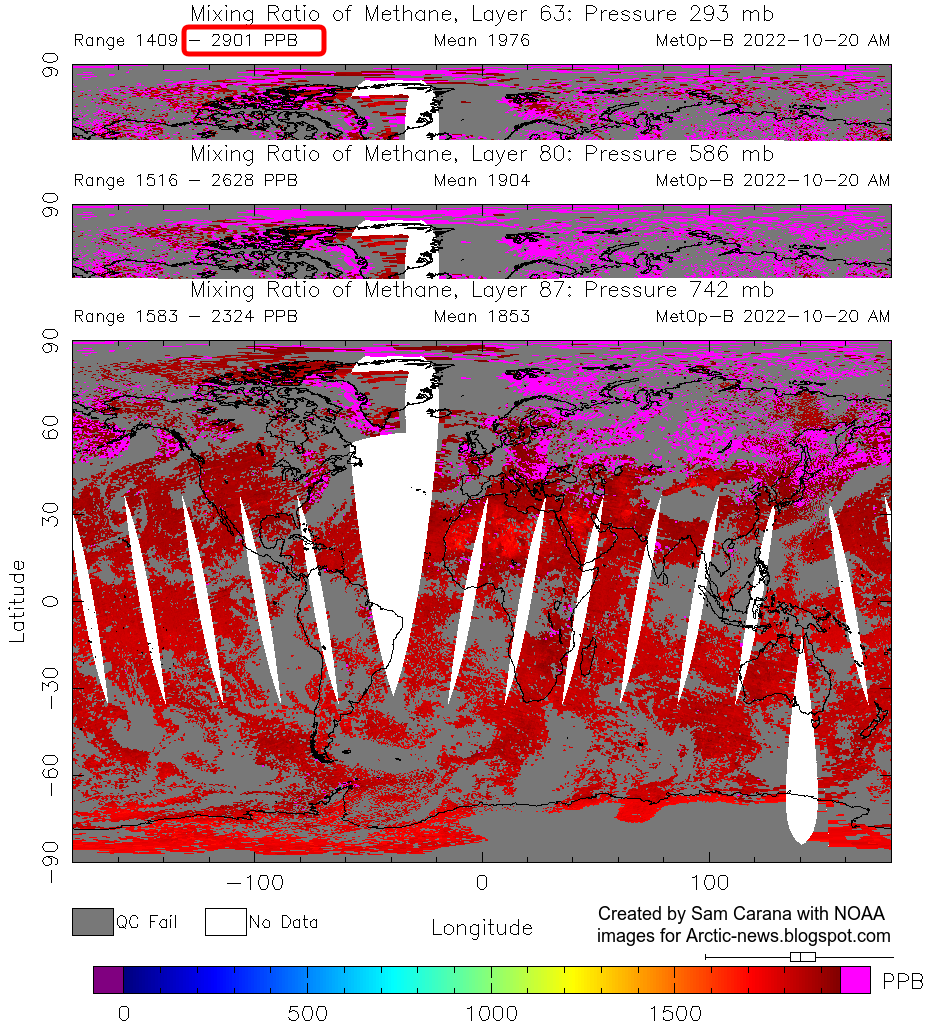
The MetOp-B satellite recorded a mean methane level of 1981 ppb at 293 mb on October 2, 2022 am, while plenty of methane was present over the Arctic Ocean at the three altitudes shown on compilation image below.
The MetOp-B satellite recorded a peak methane level of 2901 ppb at 293 mb on October 20, 2022 am, while plenty of methane was again present over the Arctic Ocean at the three altitudes shown on the compilation image below.

This supports the possibility that large amounts of methane are getting released from the Arctic Ocean, with even more to follow.

While the IPCC keeps hiding the potential for a huge rise in temperature by 2026, as discussed in an earlier post, a recently-published article points out that prudent risk management requires consideration of bad-to-worst-case scenarios. 

How bad could it be? A 2016 analysis warned that there could be a temperature rise of more than 10°C from pre-industral by 2026. An additional danger is that, as methane keeps rising, the clouds tipping point could be crossed even earlier than in 2026. Let's re-evaluate these dangers. 

The above 1981 ppb mean methane level translates into 396.2 ppm CO₂e at a 1-year GWP of 200. Destabilization of sediments at the seafloor of the Arctic Ocean could cause a large abrupt burst of methane to enter the atmosphere over the Arctic Ocean. A doubling of the mean methane level could push up the mean methane level to twice as much, to 792.4 ppm CO₂e, which is only 407.6 ppm CO₂ away from the 1200 ppm CO₂e clouds tipping point that on its own could push up the temperature by some 8°C globally. This gap of 407.6 ppm CO₂ could be more than covered by the current carbon dioxide level. The September 2022 CO₂ level at Mauna Loa was higher than that, i.e. 415.96 ppm. Since the CO₂ level at Mauna Loa in September typically is at its lowest point for the year, this implies that a large abrupt burst of methane could cause the the clouds tipping point to be instantly crossed due to methane and CO₂ alone.

Note that there are additional forcers, such as CFCs, while there are also further events and developments that could additionally speed up the temperature rise, as further discussed below. The scary situation therefore is that the clouds tipping point could be instantly crossed with a burst of methane that is far smaller in size than the methane already in the atmosphere. Such a burst of methane could be released at any time, as discussed in earlier posts such as this one

[ from earlier post ]
That's not even the worst-case scenario. In the above calculation, global mean methane levels are used. However, there is a possibility that low-lying clouds could at first break up and vanish abruptly at one specific point, due to a high methane peak, and that this could lead to break-up of neighboring clouds, propagating break-up across the globe and thus pushing up the temperature rise virtually instantly by some 8°C globally.

The MetOp satellite recorded a peak methane level of 3644 ppb and a mean level of 1944 ppb at 367 mb on November 21, 2021, pm, as discussed in an earlier post. This 3644 ppb translates into 728.8 ppm CO₂e, again at a 1-year GWP of 200. This is 471.2 ppm CO₂e away from the clouds tipping point and that 471.2 ppm CO₂e could be covered by the carbon dioxide, nitrous oxide and CFCs currently in the atmosphere.

How high could the temperature rise be by 2026? 

There are a number of scenarios that could cause the clouds tipping point to be crossed soon, e.g. if the rise in methane kept following a trend as depicted in the image below, showing WMO 2015-2021 global annual surface mean methane abundance, with a trend added.

[ click on images to enlarge ]
The trend points at a potential mean global abundance of methane of more than 700 ppm CO₂e by the end of 2026, implying that when including further forcers the clouds tipping point could be crossed in 2026. Furthermore, the trend points at 1200 ppm CO₂e getting crossed in 2028 due to the forcing of methane alone. 

Even without such an increase in methane, a huge temperature rise could eventuate by 2026, first of all due to a cataclysmic alignment of El Niño and sunspots.

We are currently in the depths of a persistent La Niña, as illustrated by the image on the right, adapted from NOAA, and this suppresses the temperature rise at the moment.

The next El Niño is already overdue, so the peak of the next El Niño may well coincide with a peak in sunspots which look set to reach a higher than expected maximum impact around July 2025. The rise in sunspots from May 2020 to July 2025 could make a difference of some 0.15°C, concluded an earlier post.

Moving from the bottom of the current La Niña to the peak of a strong El Niño could make a difference of more than half a degree Celsius, as indicated by the image below, adapted from NOAA


Therefore, the rise due to the combined impact of El Niño and sunspots could be 0.65°C by 2025. When adding this to the temperature rise that has already occurred and that, when measured from pre-industrial could be as high as 2.29°C, the total land-ocean global temperature rise could be as high as 2.94°C by 2025,  while the rise on land on the Northern Hemisphere could peak at more than 3°C above pre-industrial, noting that when there was a strong El Niño in February 2016, the land-only monthly anomaly from 1880-1920 was 2.95°C, as illustrated by the image below. 

[ from earlier post ]
Such a huge rise could cause heatwaves and droughts that could result in a huge peak in power demand, as everyone switches on their air conditioners, while at the same time rivers could either dry up or their water could become too hot to cool power plants. This could bring the grid down, which would mean that coal-fired power plants would stop emitting sulfates.

[ from Track Buckling Research ]
This could mean that equipment and appliances that need electricity such as heaters and air conditioners could stop working. Electric pumps could stop working, so there may no longer be water coming out of taps. The internet could stop working where routers require power from the grid.

Furthermore, the heat could cause asphalt and tarmac to melt and rail tracks to buckle, while airports could be closed, not only because the surface of the runway could get too hot, but also because the air could become too thin for planes to take off due to the heat.

In short, traffic, transport and industrial activities such as smelting, which are emitting a lot of sulfates as well at the moment, could grind to a halt at many places on the Northern Hemisphere. The result would be a large reduction in aerosols that are currently masking the full wrath of global warming (mainly sulfates). 

[ see the Extinction page ]
How much difference could it make? The IPCC in AR6 estimates the aerosol ERF to be −1.3 W m⁻², adding that there has been an increase in the estimated magnitude of the total aerosol ERF relative to AR5. In AR6, the IPCC estimate for liquid water path (LWP, i.e., the vertically integrated cloud water) adjustment is 0.2 W m⁻², but a recent analysis found a forcing from LWP adjustment of −0.76 W m⁻², which would mean that the IPCC estimate of −1.3 W m⁻² should be changed to -2.26 W m⁻². When using a sensitivity of ¾°C per W m⁻², this translates into an impact of -1.695°C. Since the IPCC's total for aerosols includes a net positive impact for warming aerosols such as black carbon, the impact of cooling aerosols only (without warming aerosols) will be even more negative.

This supports the 2016 analysis that warned that by 2026 there could be a 1.9°C temperature rise due to a decrease in cooling aerosols, while there could be an additional 0.6°C temperature rise due to an increase in warming aerosols and gases as a result of more biomass and waste burning and forest fires by 2026.

So, together with the upcoming El Niño and a peak in sunspots, that could result in a total rise by 2026 of 5.44°C above pre-industrial. There's more to come! Additionally, the 2016 analysis warned about further rises in temperature due to loss of Arctic sea ice and permafrost, and associated changes, as well as further rises due to gases, concluding that there could be a temperature rise by 2026 of more than 10°C compared to pre-industrial.

With a temperature rise of more than 10°C by 2026, the clouds tipping point will also be crossed, which would result in a total rise of more than 18°C by 2026. Keep in mind that humans are likely to go extinct with a rise of 3°C, as illustrated by the image below, from an analysis discussed in an earlier post.


The situation is dire and the right thing to do now is to help avoid or delay the worst from happening, through action as described in the Climate Plan.


Links

• WMO - More bad news for the planet: greenhouse gas levels hit new highs 

• WMO - Greenhouse Gas Bulletin 
https://public.wmo.int/en/greenhouse-gas-bulletin

• Ideas and perspectives: is shale gas a major driver of recent increase in global atmospheric methane? - by Robert Howarth

• NOAA - Global Monitoring Laboratory
https://gml.noaa.gov/dv/iadv

• Copernicus methane at 500 hPa, forecast for October 18, 2022, 03 UTC
https://atmosphere.copernicus.eu/charts/cams/methane-forecasts?facets=undefined&time=2022101800,3,2022101803&projection=classical_global&layer_name=composition_ch4_500hpa

• What the IPCC impacts report is hiding
https://arctic-news.blogspot.com/2022/02/what-the-ipcc-impacts-report-is-hiding.html

• Climate Endgame: Exploring catastrophic climate change scenarios - by Luke Kemp et al.
https://www.pnas.org/doi/full/10.1073/pnas.2108146119

Also discussed at:
https://www.facebook.com/groups/arcticnews/posts/10160138721434679

• The Clouds Feedback and the Clouds Tipping Point
https://arctic-news.blogspot.com/p/clouds-feedback.html

• Arctic Ocean invaded by hot, salty water

• Sunspots
https://arctic-news.blogspot.com/p/sunspots.html

• NOAA National Centers for Environmental Information, State of the Climate: Monthly Global Climate Report for September 2022, retrieved October 16, 2022
https://www.ncei.noaa.gov/access/monitoring/monthly-report/global/202209/supplemental/page-4

• NOAA Climate Prediction Center - ENSO: Recent Evolution, Current Status and Predictions 
https://www.cpc.ncep.noaa.gov/products/analysis_monitoring/lanina/enso_evolution-status-fcsts-web.pdf

• Crossing 3C
https://arctic-news.blogspot.com/2022/09/crossing-3c.html

• Pre-industrial
https://arctic-news.blogspot.com/p/pre-industrial.html

• Track Buckling Research
https://www.volpe.dot.gov/infrastructure-systems-and-technology/structures-and-dynamics/track-buckling-research

• Invisible ship tracks show large cloud sensitivity to aerosol - by Peter Manhausen et al. 

• Extinction
https://arctic-news.blogspot.com/p/extinction.html


Tuesday, April 5, 2022

Shortcomings of IPCC AR6 WGIII - Mitigation of Climate Change

In the video below, U.N. Secretary-General António Guterres comments on the launch of the IPCC AR6 WGIII SPM Mitigation report. 

[ U.N. Secretary-General António Guterres ]

The report has severe shortcomings, including: 

The IPCC makes it look as if the temperature rise could be restricted to 1.5°C above pre-industrial and insists there was a carbon budget left, to be divided by using monetary analysis. 

This narrative results in a failure to highlight in the SPM some key drivers of change (such as heat pumps in buildings and air taxis in transport) and in inappropriately referring to such key drivers of change as 'options', while failing to mention the best policies to achieve the necessary changes, i.e. through local feebates.


The agenda behind this narrative becomes further evident in phrases such as “CCS could allow fossil fuels to be used longer, reducing stranded assets” and “oil and gas assets are projected to be more at risk of being stranded toward mid-century”. 


Instead of “assets” at “risk” of getting “stranded”, these are liabilities that burden the world with a rising cost of clean-up and compensation claims. The IPCC gives CCS further undeserved importance by mentioning it no less than 32 times in the SPM, while a key driver of change such as heat pumps is mentioned only once, and not under buildings but industrial policy. 

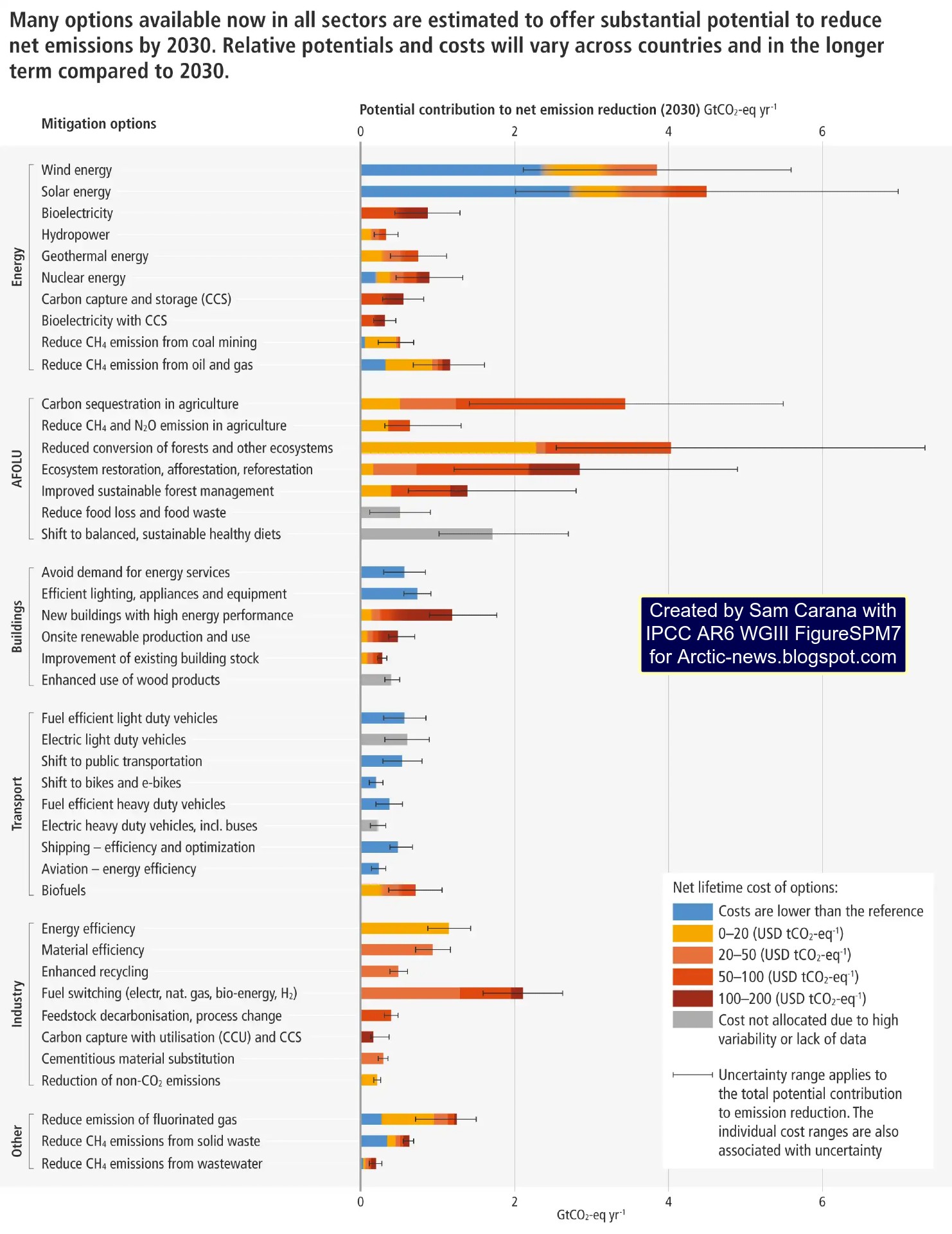
The image below, from the report's SPM, shows “options” by sector with the length of each bar indicating their potential for emissions reduction by 2030, while the color inside the bar gives a cost estimate. 

[ from IPCC AR6 WGIII SPM, click images to enlarge ]

These are not genuinely options, since the dire situation leaves little choice and instead makes it imperative to act most urgently, comprehensively and effectively on climate change, in line with the Paris Agreement. 


The Paris Agreement does instruct the IPCC to describe the best pathways to achieve this and the IPCC has until now refused to do so. As Arctic-news blog has pointed out for more than a decade, mitigation is most effectively achieved by offering people a range of options, preferably through local feebates, which will also make such policies more popular, as a 2019 analysis (above) concludes.

[ from earlier post ]

Options are more appropriately realized in the form of feebates that can offer a range of options, with the more polluting options attracting fees and with the revenues used to fund rebates on the cleaner options. 

An example of a wider set of local feebates is depicted in the above analysis of EV policy. A more diverse set of feebates could include not only fees on fuel and fuel-powered vehicles, but also on facilities that sell or process fuel, vehicle registration, parking, toll roads, etc. It's important to act comprehensively, along several lines of action, e.g. to redesign cities and plan for air taxis

Given the urgency to act, such lines of action are all best implemented as soon as possible, yet at the same time many lines of action are best kept separate, as illustrated by the above image. 

The image on the right illustrates the difference between using a Gobal Warming Potential (GWP) for methane of 171 over a few years, vs the IPCC's use of a GWP of 28 over 100 years. 


Fees on sales of livestock products can raise revenue for pyrolysis of biowaste, with the resulting biochar added to the soil.  That would also support the transition toward a vegan-organic diet more strongly, in line with the conclusion of an earlier IPCC report that a vegan diet ranks highest regarding mitigation (image right, from an earlier post). 

The Climate Plan prefers local feebates. Where needed, fees can be set high enough to effectively ban specific alternatives.

Furthermore, instead of using money, local councils could add extra fees to rates for land where soil carbon falls, while using all revenue for rebates on rates for land where soil carbon rises.

That way, biochar effectively becomes a tool to lower rates, while it will also help improve the soil's fertility, its ability to retain water and to support more vegetation. That way, real assets are built, as illustrated by the image on the right, from the 2014 post Biochar Builds Real Assets.

Catastrophic Methane Rise 

The IPCC narrative hinges on radical cuts in methane emissions from 2020, as illustrated by the image on the right. 

Instead, methane rose by 15.27 ppb in 2020 and by 16.99 ppb in 2021, the two highest growth levels since the NOAA record began in 1984. 

The combination image below shows the catastrophic rise of methane. The image in the left panel shows a trend based on January 2008-December 2021 monthly mean methane data. 

When extending this trend, current methane concentration would be 1920 ppb. Note that methane in December 2021 was 18.6 ppb higher than in December 2020, and it now is April 2022.


The situation is even worse than depicted in above image, as NOAA's data are for marine surface measurements. Methane tends to rise in the atmosphere and accumulate at higher altitudes. As illustrated by the image below, mean methane level is growing fastest at the higher altitude associated with 293 mb. 


Anyway, have another look at the combination image further above. The right panel shows that, if the trend continues, a concentration of 3840 ppb (i.e. double the current concentration) could be crossed in 2029, which would translate into a carbon dioxide equivalent (CO₂e) of 768 parts per million (ppm) at a one-year global warming potential (GWP) for methane of 200

The image on the right shows a trend that, if continued, will cross a carbon dioxide level of 450 ppm by 2029. 

Add this 450 ppm for CO₂ to 768 ppm CO₂e for methane and the joint CO₂e could be 1218 ppm in 2029, i.e. it would have crossed the point at which the clouds feedback starts to kick in (at 1200 ppm CO₂e). 

The clouds feedback could thus raise the global temperature by 8°C by 2029, but when also adding the temperature impact of greenhouse gases and further drivers, the clouds tipping point could be crossed much earlier, say by 2026, while a temperature rise of 10°C could happen even before the clouds tipping point gets reached. Drivers could include nitrous oxide (N₂O, see image right), seafloor methane, water vapor, loss of Arctic sea ice and the falling away of the aerosol masking effect, as discussed at the Extinction page.

The situation is dire and calls for comprehensive and effective action, as described in the Climate Plan.

Links


• Secretary-General Warns of Climate Emergency, Calling Intergovernmental Panel’s Report ‘a File of Shame’, While Saying Leaders ‘Are Lying’, Fuelling Flames
https://www.un.org/press/en/2022/sgsm21228.doc.htm

• Mitigation of Climate Change Report 2022: "Litany of broken climate promises" - UN Chief
https://www.youtube.com/watch?v=P8rlLaT8v4Q

• IPCC Climate Change 2022 - Mitigation of Climate Change - Summary for Policymakers
https://report.ipcc.ch/ar6wg3/pdf/IPCC_AR6_WGIII_SummaryForPolicymakers.pdf

• IPCC special report Climate Change and Land
https://www.ipcc.ch/report/srccl

• IPCC Report Climate Change and Land (review)
• Which policy can help EVs most?
https://arctic-news.blogspot.com/2019/10/which-policy-can-help-evs-most.html

• Confirm Methane's Importance
https://arctic-news.blogspot.com/2021/03/confirm-methanes-importance.html

• Biochar Builds Real Assets

• The Importance of Methane

• NOAA - Globally averaged marine surface monthly mean methane data
https://gml.noaa.gov/webdata/ccgg/trends/ch4/ch4_mm_gl.txt

• NOAA - Globally averaged marine surface annual mean methane data

• NOAA - MetOp satellite methane data - Infrared Atmospheric Sounding Interferometer (IASI)

• NOAA - Mauna Loa CO2 weekly mean and historical comparisons

• Clouds feedback

• Extinction