Arctic sea ice extent
Arctic sea ice extent was 13.53 million km² on February 28, 2026, the second lowest on record for the time of year. This is a very dangerous situation, as we're moving out of a La Niña that is suppressing temperatures into an El Niño that is elevating temperatures.

The above image is adapted from the Japanese National Institute of Polar Research and shows Arctic sea ice extent from the start of the year through early May.
The image below, adapted from NSIDC, shows that Arctic sea ice extent was second lowest on record for the time of year on February 27, 2026.

As illustrated by the image below, Arctic sea ice extent was 1.36 million km² lower than 1981-2010 on February 27, 2026 (black), the second lowest anomaly on record for the time of year and a deviation from 1981-2010 of -2.96σ.

Importantly, we're moving from a La Niña to an El Niño. The above images illustrate the impact of differences between El Niño and La Niña. The year 2016 was a strong El Niño year and Arctic sea ice extent started to decline strongly in the course of 2016 and extent remained low in 20017 and 2018. The El Niño that started to develop in 2023 contributed to the very low sea ice extent in early 2025, while sea ice extent was also lowest on record for the day during early parts of 2026. The blue line is the 2012 extent, which would turn into a record low later that year, a record that still stands today.
What happened in 2012? Let's first look into greenhouse gas concentrations, which are high in the Arctic and causing Arctic temperatures to rise strongly.

 |
| [ CO₂ concentration on Feb 22, 2026 ] |
As illustrated by the image below, methane concentrations were as high as 2498 ppb on February 19, 2026. Methane tends to be higher closer to the North Pole, while methane is particularly high at this altitude, unlike CO₂ that has its highest concentrations close to the surface.
As illustrated by the image on the right, surface concentration of carbon dioxide (CO₂) was as high as 526 ppm on February 22, 2026. The image also shows that CO₂ concentrations are high across the Arctic.
High Arctic concentrations of greenhouse gases are causing Arctic temperatures to rise strongly, contributing to decline in Arctic ice and snow cover, which causes loss of surface albedo (reflectivity).
Albedo loss is a self-amplifying feedback loop that further speeds up the temperature rise in the Arctic.
The strong rise of Arctic temperatures narrows the temperature difference between the Equator and the Arctic, which slows down the speed at which hot air flows from the Equator to the Arctic. This slowdown can hugely distort the Jet Stream and can also contribute to a slowdown of ocean currents such as the Atlantic Meridional Overturning Circulation (AMOC), which - together with ocean stratification - can contribute to more ocean heat accumulating at the surface and to less lower clouds (albedo loss).
 |
| [ Storm over Arctic Ocean, August 2012 ] |
Distortion of the Jet Stream in turn results in more extreme weather such as heatwaves, storms and fires. Fires produce soot that can settle down on the snow and ice cover and darken the surface (albedo loss). Storms can bring huge amounts of warm air into the Arctic. Furthermore, storms can churn sea ice into smaller pieces.
Early August 2012, a storm hit the Arctic Ocean, as illustrated by the image on the right. Smaller pieces of ice melt more rapidly, since more parts become exposed to ocean heat, in contrast to a large flat and solid layer of ice that is also less susceptible to wind.
Early August 2012, a storm hit the Arctic Ocean, as illustrated by the image on the right. Smaller pieces of ice melt more rapidly, since more parts become exposed to ocean heat, in contrast to a large flat and solid layer of ice that is also less susceptible to wind.
Pieces of ice that are lighter and smaller will more easily stand out above the water and capture the wind like the sails of yachts. Storms can push these smaller pieces more easily together, decreasing sea ice extent (albedo loss).
Storms can also temporarily speed up currents that are moving pieces of sea ice, with the potential to move pieces all the way out of the Arctic Ocean, where they will melt away rapidly.
Furthermore, storms can cause deeper vertical mixing of the sea water column, causing more heat to penetrate the seabed and resulting in destabilization of hydrates contained in sediments and eruption of huge amounts of methane from hydrates and from free gas held underneath the hydrates.
In conclusion, a huge retreat in Arctic sea ice extent could occur in 2026, as Jet Stream distortion is getting ever stronger due to the ongoing temperature rise and this can cause storms over the Arctic Ocean to devastate sea ice extent. A Blue Ocean Event could therefore happen in the course of 2026.
In conclusion, a huge retreat in Arctic sea ice extent could occur in 2026, as Jet Stream distortion is getting ever stronger due to the ongoing temperature rise and this can cause storms over the Arctic Ocean to devastate sea ice extent. A Blue Ocean Event could therefore happen in the course of 2026.
The 2026 El Niño
During La Niña, heat builds up underneath the sea surface, so sea surface temperatures and air temperatures get suppressed. During El Niño, ocean heat comes to the sea surface and air temperatures are elevated.
The image below shows ERA5 daily sea surface temperature anomalies (60°S-60°N) from 1 January 2023 through 25 February 2026, with an added trend, warning about the potential for a steep temperature rise in 2026.
During La Niña, heat builds up underneath the sea surface, so sea surface temperatures and air temperatures get suppressed. During El Niño, ocean heat comes to the sea surface and air temperatures are elevated.
The image below shows ERA5 daily sea surface temperature anomalies (60°S-60°N) from 1 January 2023 through 25 February 2026, with an added trend, warning about the potential for a steep temperature rise in 2026.
 |
| [ the image is discussed at Arcticnews on facebook ] |
 |
| [ El Niño outlook ] |
Moving from the bottom of a La Niña to the peak of a strong El Niño alone can make a difference of more than 0.5°C, as discussed in an earlier post.
The image on the right, adapted from NOAA, shows Niño-3.4 region temperature anomalies and forecasts, indicating that El Niño will emerge in the course of 2026.
The image on the right, adapted from NOAA, shows Niño-3.4 region temperature anomalies and forecasts, indicating that El Niño will emerge in the course of 2026.
The image below, also adapted from NOAA, shows El Niño years (red), La Niña years (blue) and neutral years (grey).
 |
| [ image from earlier post ] |
 |
| [ image from earlier post, click on images to enlarge ] |
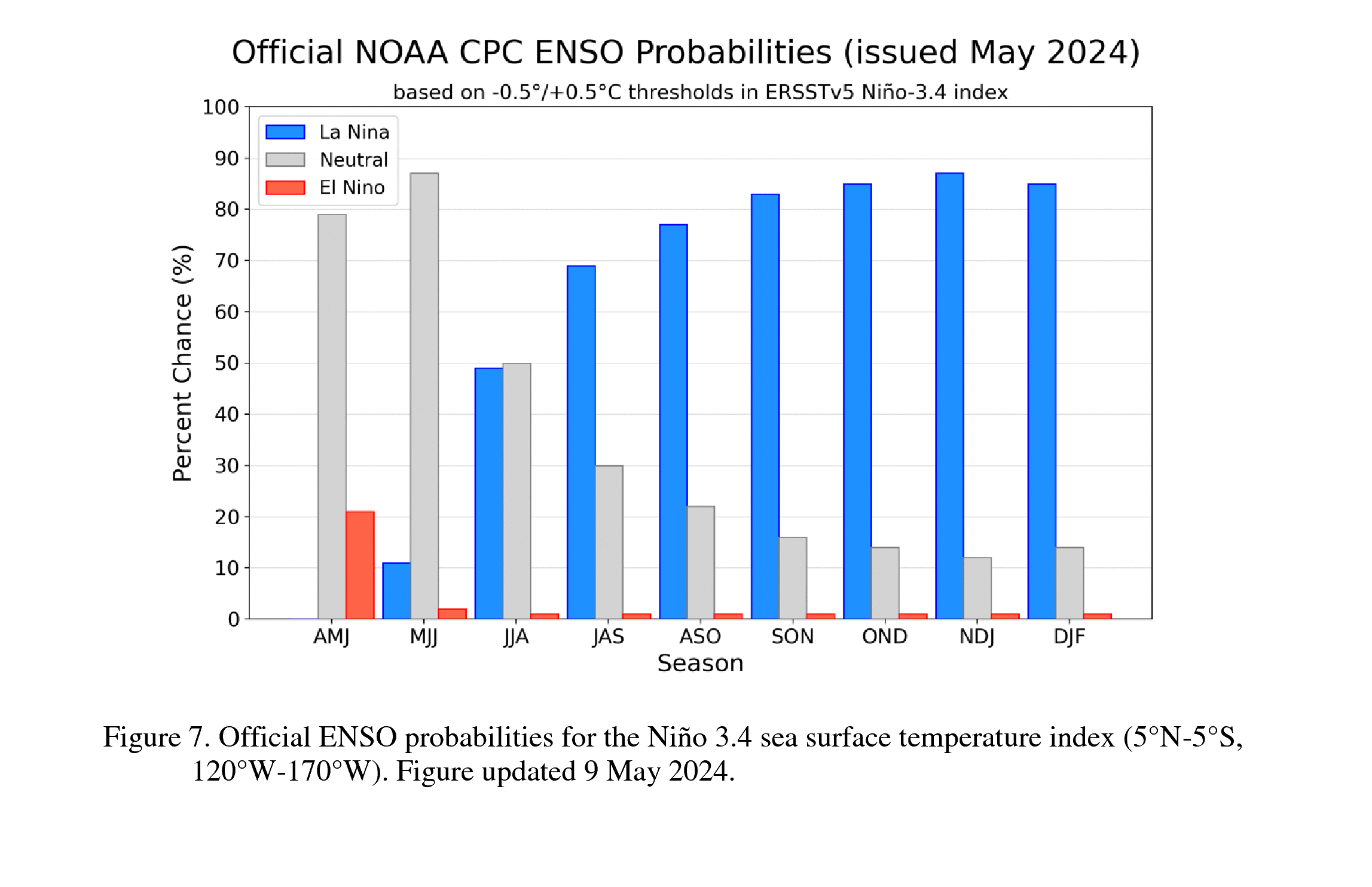
The image on the right, adapted from NOAA, shows ENSO (El Niño-Southern Oscillation) probabilities for the Niño3.4 region (5°N-5°S,120°W-170°W) relative sea surface temperature index, with El Niño (red bar) emerging in the course of 2026.
The combination image below, adapted from ECMWF, shows ENSO anomalies and forecasts for developments through February 2027 in Niño3.4 (left panel) and in Niño1+2 (right panel), indicating that the next El Niño will emerge and strengthen in the course of 2026.
The combination image below, adapted from ECMWF, shows ENSO anomalies and forecasts for developments through February 2027 in Niño3.4 (left panel) and in Niño1+2 (right panel), indicating that the next El Niño will emerge and strengthen in the course of 2026.
 |
| [ image from earlier post ] |
The combination image below, also adapted from ECMWF, shows anomalies and forecasts through August 2026 in the Niño3 region (left panel) and the Niño1+2 region (right panel).
 |
| [ image from earlier post ] |

Nick Breeze talks with Jennifer Francis about the upcoming El Niño in the video below, also discussed on facebook.
Ocean heat is another contributor to Arctic sea ice loss and ocean heat keeps melting sea ice all year long from below.
Latent heat is energy associated with a phase change, such as the energy consumed when ice turns into water. During a phase change, the temperature remains constant. As long as there is ice, additional heat will be absorbed by the process of ice turning into water, so the temperature doesn't rise at the surface.
The amount of energy absorbed by melting ice is as much as it takes to heat an equivalent mass of water from zero to 80°C.

The image below, from an earlier post, shows monthly Arctic sea ice volume in the past 25 years. Markers show April (blue) and September (red) volume, corresponding with the year's maximum and minimum. In 2025, Arctic sea ice reached a record low maximum volume as well as a record low minimum volume.

There is a huge danger that seafloor methane and methane from thawing terrestrial permafrost will add strongly and abruptly to the temperature rise, as discussed in many earlier posts such as this one and as illustrated by the screenshot below.
Warmer water flowing into the Arctic Ocean causes Arctic sea ice to lose thickness and thus volume, diminishing its capacity to act as a buffer that consumes ocean heat entering the Arctic Ocean from the North Atlantic. This means that - as sea ice thickness decreases - a lot of incoming ocean heat can no longer be consumed by melting the sea ice from below, and the heat will therefore contribute to higher temperatures of the water of the Arctic Ocean. The danger of this is described in the screenshot below.
 |
| [ screenshot from earlier post ] |
The image below shows that Arctic sea ice volume was at a record daily low on February 28, 2026.

The situation is dire and unacceptably dangerous

The image below shows a temperature anomaly forecast for February 27, 2026, adapted from tropicaltidbits.com, with anomalies at the top end of the scale (28°C) showing up over most of the Arctic Ocean. The image also illustrates to what extent cold air has descended from the Arctic over Russia and North America, with more background as to why this is happening discussed in a recent post.


• a strong 2026 El Niño could trigger a cascade of feedbacks, including:
• a Blue Ocean Event (minimal Arctic sea ice), resulting in huge loss of albedo,
• with crossing of the latent heat tipping point (loss of ice buffer), resulting in
• seafloor CH₄ hydrates destabilization and eruption of vast amounts of CH₄, and
• submarine and terrestrial permafrost thawing, resulting in even more emissions,
• and further Jet Stream distortion, causing even more extreme weather events,
• resulting in forest fires, initially in Siberia, Alaska and Canada, and also in
• droughts and fires in global peatlands and in tropical rainforests, causing
• rapid melting and thaw of mountaintop snow and ice, initially causing flooding,
• followed by droughts, fires, water shortages, famine, heatwaves, starvation,
• resulting in massive biodiversity loss, while infrastructure collapses, and
• the Greenland Ice Sheet and parts of the Antarctic Ice Sheet collapse, causing
• massive flooding of coastal areas, next to a huge rise in temperature,
• while more water vapor in the air causes the temperature rise to speed up further.
 |
| [ image from earlier post, also discussed on facebook ] |
Climate Emergency Declaration
The situation is dire and unacceptably dangerous, and the precautionary principle necessitates rapid, comprehensive and effective action to reduce the damage and to improve the outlook, where needed in combination with a Climate Emergency Declaration, as described in posts such as in this 2022 post and this 2025 post, and as discussed in the Climate Plan group.

The situation is dire and unacceptably dangerous, and the precautionary principle necessitates rapid, comprehensive and effective action to reduce the damage and to improve the outlook, where needed in combination with a Climate Emergency Declaration, as described in posts such as in this 2022 post and this 2025 post, and as discussed in the Climate Plan group.

Links
• Japanese National Institute of Polar Research
https://ads.nipr.ac.jp/vishop
• NSIDC - Sea Ice Extent
• Danish Meteorological Institute - Arctic sea ice volume and thickness
https://ocean.dmi.dk/arctic/icethickness/thk.uk.php
• Blue Ocean Event
https://arctic-news.blogspot.com/p/blue-ocean-event.html
• The threat of seafloor methane eruptions
https://arctic-news.blogspot.com/2025/11/the-threat-of-seafloor-methane-eruptions.html
• Transforming Society
https://arctic-news.blogspot.com/2022/10/transforming-society.html
• Climate Plan
https://arctic-news.blogspot.com/p/climateplan.html
• Climate Emergency Declaration
https://arctic-news.blogspot.com/p/climate-emergency-declaration.html
• The threat of seafloor methane eruptions
https://arctic-news.blogspot.com/2025/11/the-threat-of-seafloor-methane-eruptions.html
• Transforming Society
https://arctic-news.blogspot.com/2022/10/transforming-society.html
• Climate Plan
https://arctic-news.blogspot.com/p/climateplan.html
• Climate Emergency Declaration
https://arctic-news.blogspot.com/p/climate-emergency-declaration.html