The Ozone Layer
 |
| [CC image, credit: nptel.ac.in ] |
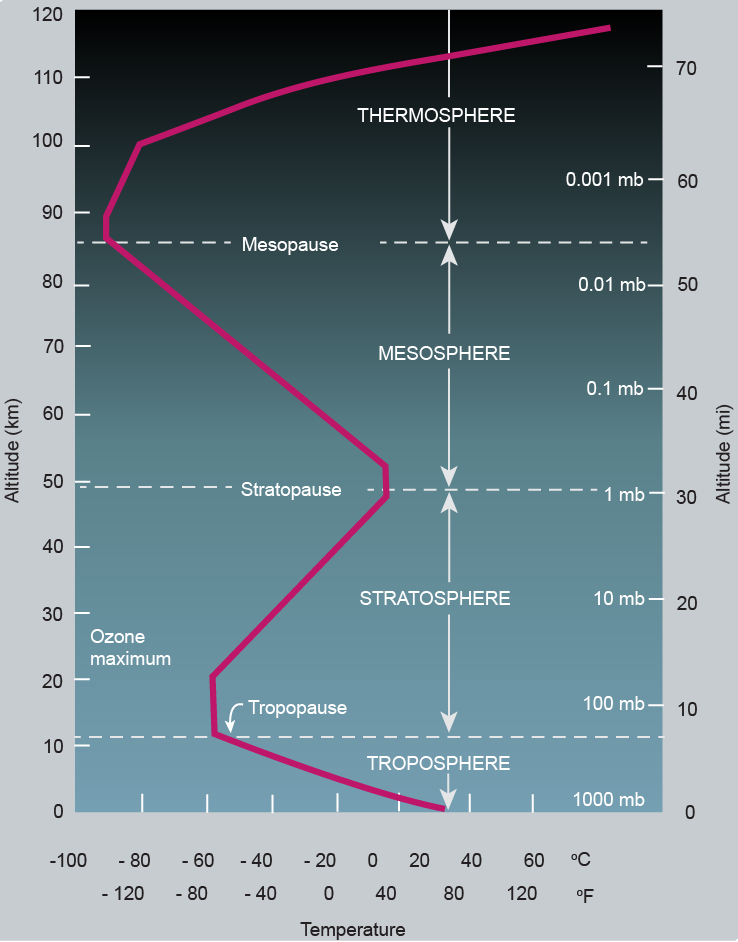
The temperature rises or falls in a different way in each of these layers, as illustrated by the red line in the image CC from archive.nptel.ac.in on the right and the scale on the bottom.
The ozone layer is located in the lower stratosphere at an altitude of 15 to 35 km or 9 to 22 miles above the Earth's surface, with the highest concentrations usually peaking around 25 km. This altitude corresponds with a pressure level of 100 to 10 mb or hPa.
The ozone layer absorbs 97% to 99% of the Sun's medium-frequency ultraviolet light (from about 200 nm to 315 nm wavelength), which otherwise could cause severe damage to life on Earth.
Water vapor rising over Antarctica
The image below shows a temperature anomaly forecast for July 3, 2026. At this time of year very little sunlight is reaching Antarctica, so the temperature over Antarctica can get very low. At the same time, global warming has increased sea surface temperatures and this also keeps air temperatures over water relatively warm. The difference in temperature strengthens wind patterns from the Southern Ocean to Antarctica, which can lead to atmospheric rivers moving toward Antarctica, carrying water vapor and heat from the Southern Ocean to Antarctica.

The red color on the above image indicates high temperature anomalies over Antarctica. The dark blue areas indicate where snow has fallen over the sea ice around Antarctica and over the interior of Antarctica.

As temperatures rise, the water vapor in the air increases. The amount of water vapor that the air can hold rises by 7% for each 1°C temperature rise (Clausius-Clapeyron relation). While much of the water vapor will fall out of the air as precipitation, in the form of rain or snow, some of the water vapor will remain in the air. This extra water vapor increases temperatures, since water vapor is a strong greenhouse gas. The IPCC adds: Water vapor feedback acting alone approximately doubles the warming from what it would be for fixed water vapor. Furthermore, water vapor feedback acts to amplify other feedbacks in models, such as cloud feedback and ice albedo feedback. If cloud feedback is strongly positive, the water vapor feedback can lead to 3.5 times as much warming as would be the case if water vapor concentration were held fixed.
Part of the precipitation will fall over Antarctica in the form of snow, thickening the snow cover there, without returning to the surface of the Southern Ocean. The net result is that the salinity of the Southern Ocean surface increases, facilitating increased melting of Antarctic sea ice, further speeding up the temperature rise, as also discussed in earlier posts such as this one.
The threat is further illustrated by the image below, which shows a forecast of precipitable water standardized anomalies on June 30, 2026.

 |
| [ minus 70.2°C near South Pole ] |
The Jet Stream in the Southern Hemisphere is now very powerful, since the temperature difference is large between the Equator and the South Pole, where temperatures lower than -70°C are recorded, as illustrated by the image on the right.
The situation is further illustrated by the image below, dated July 25, 2026, 09:00 UTC. At a location marked by the green circle, wind at 250 hPa reaches a speed of 321 km/h, while Instantaneous Wind Power Density is 143.1 kW/m².

This can at times cause the Jet Stream to move over parts of Antarctica, enabling warm, moist air to move from the Southern Ocean over Antarctica, which can result in very high temperatures anomalies, as illustrated by the image below that shows a forecast with areas over Antarctica reaching temperature anomalies of about +30°C on July 18, 2026, i.e. winter heatwave conditions in Antarctica.

In the video below, Guy McPherson discussed warming of Antarctica.
Damage to the Ozone Layer
Furthermore, part of the extra water vapor can rise up and moisten the atmosphere up to and above the ozone layer. The combination image below shows relative humidity on June 30, 2026 at 01:00 UTC, with relative humidity reaching up to 100% at surface level (left), up to 100% at 70 mb or hPa (center), and up to 23% at 10 mb or hPa (right).

 |
| [ from earlier post ] |
Increases in stratospheric water vapor are bad news, as they not only speed up global warming but also lead to loss of stratospheric ozone, as Drew Shindell pointed out back in 2001.
It has long been known that deterioration of the ozone shield increases ultraviolet-B irradiation, in turn causing skin cancer.
Research (box right) suggests that, millions of years ago, it could also have led to loss of fertility and consequent extinction in plants and animals.
Research (box right) suggests that, millions of years ago, it could also have led to loss of fertility and consequent extinction in plants and animals.
Water vapor reaching stratospheric altitudes causes ozone depletion, as James Anderson describes in a 2017 paper and discusses in the short 2016 video below.
[ from earlier post ]
A recent study led by Yifeng Peng finds that moderate volcanic eruptions and extreme wildfires since 2005 have systematically increased stratospheric water vapor. Both contribute through aerosol-induced tropopause warming; extreme wildfires also reveal an additional self-lofting pathway that transports water vapor into the stratosphere. Conclusion

The situation looks set to deteriorate further. More water vapor causes more warming, since water vapor is a potent greenhouse gas. As more snow falls over Antarctica, the sea surface of the Southern Ocean increases in salinity, which speeds up melting of sea ice. The extra water vapor and increased melting of sea ice can both strongly accelerate the temperature rise, while water vapor that reaches the stratosphere also causes damage to the ozone layer.
The situation is dire and unacceptably dangerous, and the precautionary principle necessitates the danger to be acknowledged, while facilitating rapid, comprehensive and effective action to reduce the damage and to improve the outlook, where needed in combination with a Climate Emergency Declaration, as described in posts such as in this 2022 post and this 2025 post, and as discussed in the Climate Plan group.

Links
https://arctic-news.blogspot.com/p/moistening-atmosphere.html
• Care for the Ozone Layer
https://arctic-news.blogspot.com/2019/01/care-for-the-ozone-layer.html
• Science Snippets: The Catastrophic Warming of Antarctica - video by Guy McPherson
• Double Blue Ocean Event 2026-2027? - update
https://arctic-news.blogspot.com/2026/06/double-blue-ocean-event-2026-2027-update.html
• Moderate volcanic eruptions and extreme wildfires humidify the stratosphere - by Yifeng Peng et al.
https://www.nature.com/articles/s41586-026-10731-0
• Moderate volcanic eruptions and extreme wildfires humidify the stratosphere - by Yifeng Peng et al.
https://www.nature.com/articles/s41586-026-10731-0
discussed on facebook at:
https://www.facebook.com/groups/arcticnews/posts/10164444744564679
https://www.facebook.com/groups/arcticnews/posts/10164444744564679
• Transforming Society
https://arctic-news.blogspot.com/2022/10/transforming-society.html
• Climate Plan
https://arctic-news.blogspot.com/p/climateplan.html
• Climate Emergency Declaration
https://arctic-news.blogspot.com/p/climate-emergency-declaration.html


