The 2026 El Niño
 |
| [ click on images to enlarge ] |
Moving from the bottom of a La Niña to the peak of a strong El Niño alone can make a difference of more than 0.5°C, as discussed in an earlier post.
The image on the right, adapted from NOAA, shows Niño-3.4 region temperature anomalies and forecasts, indicating that El Niño will emerge in the course of 2026.
The image below, also adapted from NOAA, shows El Niño years (red), La Niña years (blue) and neutral years (grey).


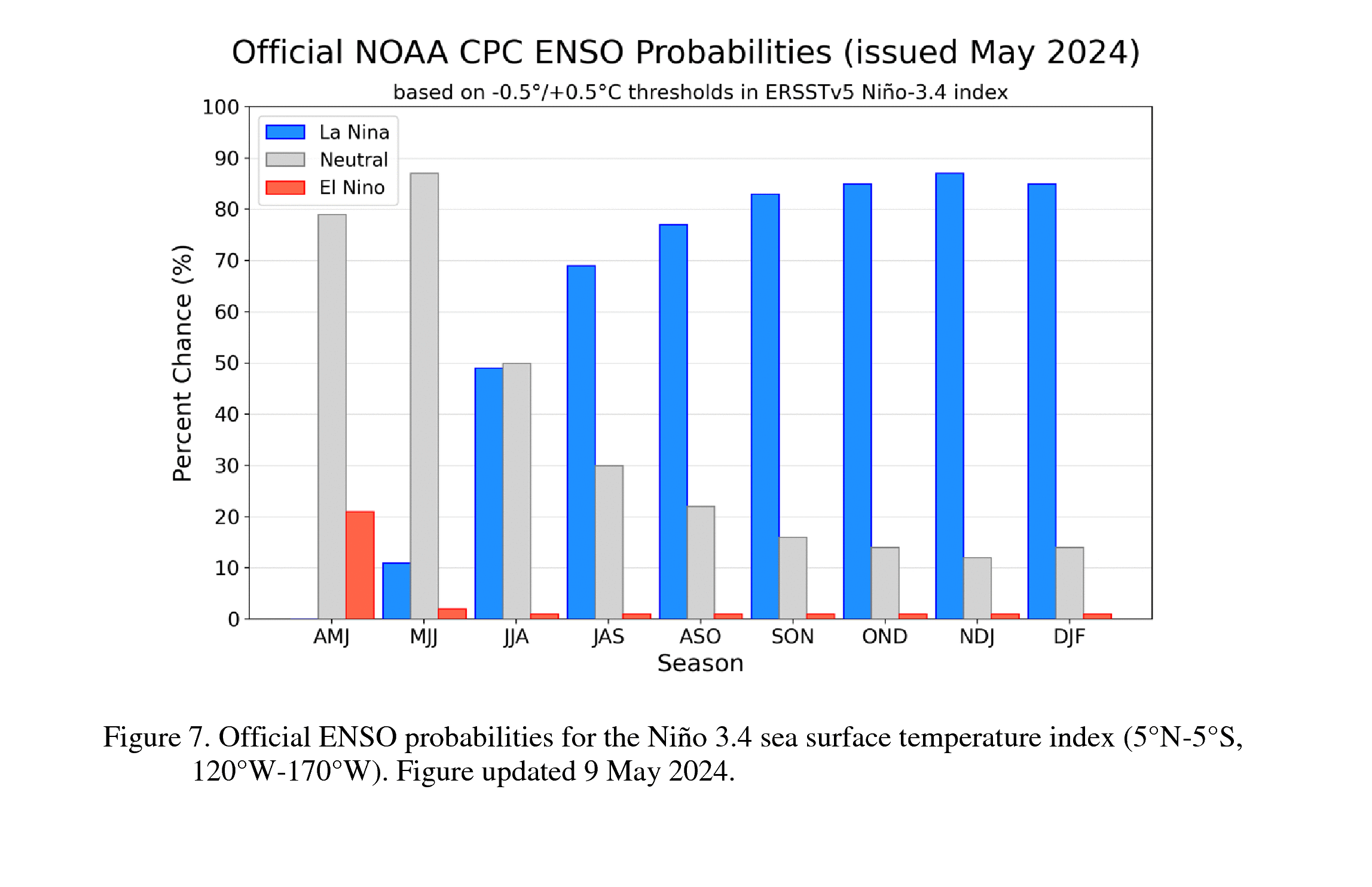
The image on the right, adapted from NOAA, shows ENSO (El Niño-Southern Oscillation) probabilities for the Niño3.4 region (5°N-5°S,120°W-170°W) relative sea surface temperature index, indicating El Niño (red bar) will emerge and strengthen in the course of 2026.
The combination image below, adapted from ECMWF, shows ENSO anomalies and forecasts for developments through February 2027 in Niño3.4 (left panel) and in Niño1+2 (right panel), indicating that the next El Niño will emerge and strengthen in the course of 2026.
 |
| [ image from earlier post ] |
The combination image below, also adapted from ECMWF, shows anomalies and forecasts through September 2026 in the Niño3.4 region (left panel) and the Niño1+2 region (right panel).

Sea surface temperature anomalies exceeding 2°C in the NINO3.4 region indicate a "super" or very strong El Niño event.
Zeke Hausfather made the image below based on forecasts by different modeling groups that suggest that we might see an event comparable in strength to what we saw in 2016.
 |
| [ click on images to enlarge ] |
The image below, adapted from tropicaltidbits.com, shows a rise since early January 2026 of more than 2.5°C in sea surface temperature anomalies (CDAS data) in the Niño1+2 region from early January 2026 to March 1, 2026.

Forests burning
The image below, adapted from Copernicus, shows high levels of carbon dioxide over South America, Central Africa and India on March 14, 2026, indicating massive burning of forests and crop residues.

Ocean temperatures
During La Niña, heat builds up underneath the sea surface, so sea surface temperatures and air temperatures get suppressed. The image below, adapted from NOAA, illustrates ocean heat building up in the Equatorial Pacific region.

During El Niño, more ocean heat comes to the sea surface and more ocean heat gets transferred to the atmosphere, resulting in elevated air temperatures.
The image below shows world (60°S–60°N, 0–360°E) sea surface temperatures from NOAA OISST V2.1. The sea surface temperature was 21.15°C on March 24, 2026, a record high temperature for the time of year and a +0.74°C anomaly compared to 1982-2010. The sea surface temperature has risen by 0.46°C since the start of 2026.

Furthermore, changes in salinity and ocean currents, together with ocean stratification, ocean oxygen depletion and sea ice loss can result in oceans changing from heat sinks into heat sources, resulting in more heat remaining in the air and getting transferred to the air, as discussed in earlier post such as this one and as discussed in this analysis, also discussed here. The danger is illustrated by the image below.
 |
| [ image from earlier post, discussed on facebook and also at the Arcticnews group on facebook ] |
The upcoming El Niño could trigger a rapid and steep rise in temperature. The above image shows ERA5 daily sea surface temperature anomalies (60°S-60°N) from 1 January 2023 through 25 February 2026, with an added trend, warning about the potential for a steep temperature rise in 2026.

The above image shows NASA February 2026 Land+Ocean temperature anomalies as high as 6.6°C with an average of 1.24°C above 1951-1980.
Land-only temperatures

The above image was created with NASA Land Only temperature anomalies versus 1880-1890 (not pre-industrial) through February 2026. The image shows that the 1.5°C threshold was crossed on land for all months since 2022 (black squares). The Lowess 3-year smoothing trend (red line) indicates that the 2°C threshold was crossed on land since 2022. The dashed red line is a linear extension of the red line that indicates that the 3°C threshold may get crossed soon, possibly half 2029 if this linear trend continues (dashed red extension).
The images below and above focus on land-only temperatures, since virtually all people live on land (rather than oceans), which makes it critical for people to know by how much temperatures could rise on land.
Some suggest that one decade was too short to qualify as a climate period. Climate change generally does take place over many years, as opposed to seasonal changes that take place within a period of one or a few years time, while the weather can change by the hour. Yet, acceleration in the rise in temperature over a short period of time should not be ignored in discussions about climate change and action on climate change.
The image below shows 15 years of NASA Land-Only temperature anomalies versus 1880-1920 (not pre-industrial) with a quartic trend added that points at the 3°C threshold getting crossed in 2027. The trend is calculated over 16 years of data, so when adding 16 years into the future, a trend that has the start of 2026 at its center would cover a 32-year period if extended to the year 2041.
The canvas in the image below shows a yellow trend starting in 2011, with the dashed part for the years 2026 and 2027 constituting an extension of the trend made visible for years for which no annual data are yet available. The canvas of the image is limited to 3°C for the vertical axis and to the start of the year 2028 for the horizontal axis, since humans are likely to go extinct with a 3°C rise. So, while the canvas is limited, the trend actually covers a period of 32 years.
Some suggest that one decade was too short to qualify as a climate period. Climate change generally does take place over many years, as opposed to seasonal changes that take place within a period of one or a few years time, while the weather can change by the hour. Yet, acceleration in the rise in temperature over a short period of time should not be ignored in discussions about climate change and action on climate change.
The image below shows 15 years of NASA Land-Only temperature anomalies versus 1880-1920 (not pre-industrial) with a quartic trend added that points at the 3°C threshold getting crossed in 2027. The trend is calculated over 16 years of data, so when adding 16 years into the future, a trend that has the start of 2026 at its center would cover a 32-year period if extended to the year 2041.
The canvas in the image below shows a yellow trend starting in 2011, with the dashed part for the years 2026 and 2027 constituting an extension of the trend made visible for years for which no annual data are yet available. The canvas of the image is limited to 3°C for the vertical axis and to the start of the year 2028 for the horizontal axis, since humans are likely to go extinct with a 3°C rise. So, while the canvas is limited, the trend actually covers a period of 32 years.
 |
| [ Could a steep rise in land-only temperatures occur soon? ] |
Such trends should not be confused with near-future temperature forecasts or predictions. The image poses questions such as whether a steep rise in land-only temperatures could occur soon. The debate page further discusses whether the danger can best be highlighted using data dating back only a few years, whether linear or non-linear trends should be used, etc.
Polynomial trends such as the one in the above image can highlight warnings about dangers that are discussed in this post and in earlier posts, i.e. warnings that a strong El Niño may be on the way that could cause a strong rise in temperature in the course of 2026, a rise that would come on top of a temperature rise that is already accelerating due to high concentrations of greenhouse gases, while deforestation and numerous feedbacks are kicking in with greater ferocity, and while the temperature rise is amplified in the Arctic, which could lead to a Blue Ocean Event soon, further speeding up the temperature rise and resulting in loss of permafrost, eruption of methane from the seafloor of the Arctic Ocean, further loss of lower clouds, etc.
Arctic temperatures

The above image shows that the 2025 Arctic temperature was 3.431°C higher than in 1951-1980. The only year on record that had an anomaly higher than 2025 was 2016, when there was a super El Niño.

 |
| [ click on images to enlarge ] |
The above image shows a sea surface temperature anomaly forecast for August 2026, adapted from tropicaltidbits.com, with sea surface temperature anomalies higher than 5°C showing up over much of the Arctic Ocean.
The image below shows a 2-meter temperature anomaly forecast for November 2026, adapted from tropicaltidbits.com, with anomalies at the top end of the scale (13°C) showing up over most of the Arctic Ocean.
 |
| [ image from earlier post, click on images to enlarge ] |
The image below shows a 2-meter temperature anomaly forecast for December 2026, adapted from tropicaltidbits.com, with very high anomalies again showing up over most of the Arctic Ocean.

Arctic sea ice
The image below, adapted from ads.nipr.ac.jp/vishop, shows that the Arctic sea ice was 13.38 million km² in extent on March 24, 2026, the lowest extent on record for the time of year.

The image below, adapted from NSIDC, shows that on March 24, 2026, the Arctic sea ice extent was 14.024 million km², the lowest extent on record for the time of year.

This is a very dangerous situation, since we're moving out of a La Niña (which is suppressing the temperature) into an El Niño (which will be elevating the temperature), as also described in a recent post.
The image below shows that the Arctic sea ice extent anomaly was 1.38 million km² lower than 1981-2010 on March 22, 2026 (black), the lowest daily anomaly on record and a deviation from 1981-2010 of -3.12σ. Also highlighted is the sea ice extent anomaly for 2016 (blue), when there was a strong El Niño.

The danger is that a Blue Ocean Event will occur in 2026 if Arctic sea ice continues to be low and if melting from April 2026 onward will be strong. A Blue Ocean Event can be said to occur when virtually no sea ice remains to keep consuming ocean heat that is entering the Arctic Ocean mainly from the Atlantic Ocean. Virtually no sea ice could be 1 million km² or less in sea ice extent, but it could also be measured in area.
The image below illustrates that the Arctic sea ice area was 13.52 million km² on March 20, 2012, and it was 12.40 million km² on March 20, 2026, i.e. a difference of 1.12 million km². Arctic sea ice area was 2.24 million km² on September 12, 2012, so if this difference persists, Arctic sea ice area would be 1.12 million km² in September 2026, or very close to a Blue Ocean Event.

The danger that a Blue Ocean Event will occur in September 2026 is further illustrated by the image below, which shows Arctic sea ice volume in the past 25 years. Markers show April (blue) and September (red) volume, corresponding with the year's maximum and minimum. In 2025, Arctic sea ice reached a record low maximum volume, as well as a record low minimum volume.

As illustrated by the above image, adapted from dmi.dk, Arctic sea ice volume was very low in April 2025, so while relatively little melting took place from April 2025 to September 2025, a record low Arctic sea ice volume was still reached in September 2025. The above image shows Arctic sea ice volume through mid February 2026, with an analysis of the strength of the melting between April (annual maximum) and September (annual minimum) by means of the bars colored magenta (strong melting) and green (little melting).
If the downward trend in annual maxima (blue circles) continues, Arctic sea ice looks set to reach an even lower maximum volume in April 2026. The difference between strong melting (magenta) and little melting (green) is 3000 km³, so if strong melting will take place from April 2026, this may well cause a Blue Ocean Event to occur later in 2026. A Blue Ocean Event could also be said to occur when only 1000 km³ or less Arctic sea ice volume remains. The image below, adapted from dmi.dk, shows that Arctic sea ice volume was at a record daily low on March 25, 2026.

The image below, adapted from Zack Labe, shows sea ice thickness near the North Pole from 1979 through February 2026.

Greenhouse gas concentration

The image below shows one year of daily (green circles), weekly (red lines) and monthly (blue lines) average carbon dioxide concentrations at Mauna Loa, Hawaii.

Climate Emergency Declaration
The situation is dire and unacceptably dangerous, and the precautionary principle necessitates rapid, comprehensive and effective action to reduce the damage and to improve the outlook, where needed in combination with a Climate Emergency Declaration, as described in posts such as in this 2022 post and this 2025 post, and as discussed in the Climate Plan group.

Proposed amendment to the Constitution

Links
• Japanese National Institute of Polar Research
https://ads.nipr.ac.jp/vishop
• NSIDC - Sea Ice Extent
https://nsidc.org/sea-ice-today/sea-ice-tools/charctic-interactive-sea-ice-graph
• Danish Meteorological Institute - Arctic sea ice volume and thickness
https://ocean.dmi.dk/arctic/icethickness/thk.uk.php
• NOAA - Ocean heat in the Equatorial Pacific region
https://www.cpc.ncep.noaa.gov/products/analysis_monitoring/enso_update/wkxzteq.shtml
• NASA - Goddard Institute for Space Studies (GISS) Surface Temperature Analysis
https://data.giss.nasa.gov/gistemp
• NASA - Goddard Institute for Space Studies (GISS) Surface Temperature Analysis
https://data.giss.nasa.gov/gistemp
image discussed on facebook at:
https://www.facebook.com/SamCarana/posts/pfbid05ToSzQwjjA4indZrf9vDfz4RdbguAjGqB6S96ftBKu68hsUjjqu8X5TqD4kAQZf1l
https://www.facebook.com/SamCarana/posts/pfbid05ToSzQwjjA4indZrf9vDfz4RdbguAjGqB6S96ftBKu68hsUjjqu8X5TqD4kAQZf1l
• Copernicus
https://atmosphere.copernicus.eu/charts/packages/cams
• Zachery Labe - sea ice thickness/volume
https://zacklabe.com/arctic-sea-ice-volumethickness
• Kevin Pluck - sea ice visuals
https://seaice.visuals.earth
• Levi Cowan - tropicaltidbits
https://www.tropicaltidbits.com
• Blue Ocean Event
https://arctic-news.blogspot.com/p/blue-ocean-event.html
• The threat of seafloor methane eruptions
https://arctic-news.blogspot.com/2025/11/the-threat-of-seafloor-methane-eruptions.html
• The 2026 El Nino
https://arctic-news.blogspot.com/2026/02/the-2026-el-nino.html
• Transforming Society
https://arctic-news.blogspot.com/2022/10/transforming-society.html
• Climate Plan
https://arctic-news.blogspot.com/p/climateplan.html
• Climate Emergency Declaration
https://arctic-news.blogspot.com/p/climate-emergency-declaration.html
• Blue Ocean Event
https://arctic-news.blogspot.com/p/blue-ocean-event.html
• The threat of seafloor methane eruptions
https://arctic-news.blogspot.com/2025/11/the-threat-of-seafloor-methane-eruptions.html
• The 2026 El Nino
https://arctic-news.blogspot.com/2026/02/the-2026-el-nino.html
• Transforming Society
https://arctic-news.blogspot.com/2022/10/transforming-society.html
• Climate Plan
https://arctic-news.blogspot.com/p/climateplan.html
• Climate Emergency Declaration
https://arctic-news.blogspot.com/p/climate-emergency-declaration.html